
- Home
- Louis L'Amour
The Lawless West
The Lawless West Read online
The Lawless West
Louis L’Amour
Zane Grey®
Max Brand®
Ready to Fight!
“You move fast.” Pinder was staring at me with small eyes. “Suppose I had cut myself in with Blacky and the ’Pache?”
My chuckle angered him. “You? I had that pegged, Jim Pinder. When my guns came out, you would have died first. You’re faster than either of those two, so you’d take yours first. Then Blacky, and after him”—I nodded toward the Apache—“him. He would be the hardest to kill.”
Pinder didn’t like it, and he didn’t like me. “I made an offer,” he said.
“And you brought these coyotes to give me a rough time if I didn’t take it? Be damned to you, Pinder! You can take your CP outfit and go to blazes!”
His lips thinned down and he stared at me. I’ve seldom seen such hatred in a man’s eyes. “Then get out!” he said. “Get out fast! Join Maclaren an’ you die!”
“Then why wait? I’m not joining Maclaren so far as I know now, but I’m staying, Pinder. Any time you want what I’ve got, come shooting. I’ll be ready.”
—from “Riders of the Dawn” by Louis L’Amour
Foreword
A short novel is a story too short to be a novel—40,000 words or less—and too long to be a short story. It was a literary form that once was encouraged and flourished when there were numerous fiction magazines published weekly, monthly, or quarterly in the United States, and it is a form at which numerous American writers excelled. Although a great many authors have written excellent Western fiction, beginning with Mark Twain and Bret Harte, only three managed as a result of their Western stories to attract a sufficient readership to become wealthy. Zane Grey, Max Brand, and Louis L’Amour were the three, and their work has endured with generations of readers throughout the world. For this collection I have selected a short novel by each of these authors, consisting of stories I regard as among their best work. This is the third, and last, time I shall do so. Earlier collections of short novels by these three authors have been titled The Golden West and The Untamed West respectively for first publication in paperback.
The greatest lesson the pioneers learned from the Indians is with us still: that it is each man’s and each woman’s inalienable right to find his own path in life, to follow his own vision, to achieve his own destiny—even should one fail in the process. There is no principle so singularly revolutionary as this one in human intellectual history before the American frontier experience, and it grew from the very soil of this land and the peoples who came to live on it. It is this principle that has always been the very cornerstone of the Western story. Perhaps for this reason critics have been wont to dismiss it as subversive and inconsequential because this principle reduces their voices to only a few among many. Surely it is why the Western story has been consistently banned by totalitarian governments and is sneered at by the purveyors of political correctness. Such a principle undermines the very foundations of totalitarianism and collectivism because it cannot be accommodated by the political correctness of those who would seek to exert power over others and replace all options with a single, all-encompassing, monolithic pattern for living.
There is no other kind of American literary endeavor that has so repeatedly posed the eternal questions—how do I wish to live?, in what do I believe?, what do I want from life?, what have I to give to life?—as has the Western story. There is no other kind of literary enterprise since Greek drama that has so invariably posed ethical and moral questions about life as a fundamental of its narrative structure, that has taken a stand and said: this is wrong; this is right. Individual authors, as individual filmmakers, may present us with notions with which we do not agree, but in so doing they have made us think again about things that the herd has always been only too anxious to view as settled and outside the realm of questioning.
The West of the Western story is a region where generations of people from every continent on earth and for ages immeasurable have sought a second chance for a better life. The people forged by the clash of cultures in the American West produced a kind of human being very different from any the world had ever known before. How else could it be for a nation emerging from so many nations? And so stories set in the American West have never lost that sense of hope. It wasn’t the graves at Shiloh, the white crosses at Verdun, the vacant beaches at Normandy, or the lines on the faces of their great men and women that made the Americans a great people. It was something more intangible than that. It was their great willingness of the heart.
What alone brings you back to a piece of music, a song, a painting, a poem, or a story is the mood that it creates in you when you have experienced it. The mood you experience in reading a Western story is that a better life is possible if we have the grit to endure the ordeal of attaining it, that it requires courage to hope, the very greatest courage any human being can ever have. And it is hope that distinguishes the Western story from every other kind of fiction. Only when courage and hope are gone will these stories cease to be relevant to all of us.
Jon Tuska
Portland, Oregon
Table of Contents
Cover Page
Title Page
Ready to Fight!
Foreword
From Missouri
Chapter 1
Chapter 2
Chapter 3
Over the Northern Border
Chapter 1
Chapter 2
Chapter 3
Chapter 4
Chapter 5
Chapter 6
Chapter 7
Chapter 8
Chapter 9
Chapter 10
Chapter 11
Riders of the Dawn
Chapter 1
Chapter 2
Chapter 3
Chapter 4
Chapter 5
Chapter 6
Chapter 7
Chapter 8
Chapter 9
Chapter 10
Chapter 11
Chapter 12
Other Leisure Trilogies by Louis L’Amour, Zane Grey® & Max Brand®:
Copyright
From Missouri
ZANE GREY®
Zane Grey (1872-1939) was born Pearl Zane Gray in Zanesville, Ohio. He was graduated from the University of Pennsylvania in 1896 with a degree in dentistry. He conducted a practice in New York City from 1898 to 1904, meanwhile striving to make a living by writing. He met Lina Elise Roth in 1900 and always called her Dolly. In 1905 they were married. With Dolly’s help, Grey published his first novel himself, Betty Zane (Charles Francis Press, 1903), a story based on certain of his frontier ancestors. Eventually closing his dental office, Grey moved with Dolly into a cottage on the Delaware River, near Lackawaxen, Pennsylvania. It is now a national landmark.
Although it took most of her savings, it was Dolly Grey who insisted that her husband take his first trip to Arizona in 1907 with C. J. “Buffalo” Jones, a retired buffalo hunter who had come up with a scheme for crossing the remaining bison population with cattle. Actually Grey could not have been more fortunate in his choice of a mate. Dolly Grey assisted him in every way he desired and yet left him alone when he demanded solitude; trained in Englishat Hunter College, she proof-read every manuscript he wrote and polished his prose; she managed all financial affairs and permitted Grey, once he began earning a good income, to indulge himself at will in his favorite occupations, hunting, fishing, sailing, and exploring the Western regions.
After his return from that first trip to the West, Grey wrote a memoir of his experiences titled The Last of the Plainsmen (Outing, 1908) and followed it with his first Western romance, The Heritage of the Desert (Harper, 1910). It remains one of his fine
st novels. The profound effect that the desert had had on him was vibrantly captured so that, after all of these years, it still comes alive for a reader. In a way, too, it established the basic pattern Grey would use in much of his subsequent Western fiction. The hero, Jack Hare, is an Easterner who comes West because he is suffering from tuberculosis. He is rejuvenated by the arid land. The heroine is Mescal, desired by all men but pledged by the Mormon church to a man unworthy of her. Mescal and Jack fall in love, and this causes her to flee from Snap Naab, for whom she would be a second wife. Snap turns to drink, as will many another man rejected by heroines in other Grey romances, and finally kidnaps Mescal. The most memorable characters in this novel, however, are August Naab, the Mormon patriarch who takes Hare in at his ranch, and Eschtah, Mescal’s grandfather, a Navajo chieftain of great dignity and no less admirable than Naab. The principal villain—a type not too frequently encountered in Grey’s Western stories—is Holderness, a Gentile and the embodiment of the Yankee business spirit that will stop at nothing to exploit the land and its inhabitants for his own profit. Almost a century later, he is still a familiar figure in the American West, with numerous bureaucratic counterparts in various federal agencies. In the end Holderness is killed by Hare, but then Hare is also capable of pardoning a man who has done wrong if there is a chance for his reclamation, a theme Grey shared with Max Brand.
Grey had trouble finding a publisher for his early work, and it came as a considerable shock to him when his next novel, Riders of the Purple Sage, arguably the greatest Western story ever published, was rejected by the same editor who had bought The Heritage of the Desert. Grey asked the vice president at Harper & Bros. to read the new novel. Once he did, and his wife did, it was accepted for publication. However, the version that ultimately appeared was extensively bowdlerized. Finally, after more than ninety years, Riders of the Purple Sage has been restored and published as Zane Grey wrote it.
The same censorship process that had plagued Riders of the Purple Sage was also much in evidence when Grey wrote his sequel to it, The Desert Crucible. Significant parts of this story were suppressed at the time the book, titled The Rainbow Trail, was published by Harper & Bros. in 1915. Among the most significant of these parts of the story is that Fay Larkin, the heroine, is forced into a marriage with one of her Mormon captors, a man with five wives and fifty-five children, forced for two years to live as a sealed wife, during which time she gives birth to a child. A confession concerning all of this is brought into evidence at her trial before a Supreme Court judge following her arrest by the Department of Justice on a charge of polygamy. Actually, due to editorial interventions at the time Zane Grey wrote his finest fiction, what he really wrote in his best books has not been published until now, making worthless much of the literary criticism of Grey as an author since it has been based on bogus editions. These restorations follow other equally notable Zane Grey titles published for the first time in book form, based on his holographic manuscripts: Last of the Duanes, Rangers of the Lone Star, Woman of the Frontier, The Great Trek, Open Range, and Tonto Basin. Similarly it was necessary to go back to Zane Grey’s handwritten manuscripts to publish his short stories, contained so far in two collections: The Westerners (Five Star, 2000) and Rangle River (Five Star, 2001). In The Golden West, “Tappan’s Burro” appeared for the first time as Zane Grey intended, and the same is true for “Cañon Walls” that appeared in its restored version in The Untamed West.
Yet, despite the difficulties Grey encountered in getting his stories published as he wrote them, what did appear led to a degree of success that exceeded even his wildest dreams. The magazine serials, the books, the motion picture versions—and Grey at 108 films still holds the world’s record for cinematic derivations based on the works of a single author—brought in a fortune. He had homes on Catalina Island, in Altadena, California, a hunting lodge in Arizona, a fishing lodge in the Rogue River area in Oregon.
Whatever his material prosperity, Grey continued to believe in the strenuous life. His greatest personal fear was that of growing old and dying. It was while fishing the North Umpqua River in Oregon in the summer of 1937 that Grey collapsed from an apparent stroke. It took him a long time to recover use of his faculties and his speech. Cardiovascular disease was congenital on Grey’s side of the family. Despite medical advice to the contrary, Grey refused to live a sedentary life. He was convinced that the heart was a muscle and the only way to keep it strong was to exercise it vigorously. Early in the morning on October 23, 1939, Dolly was awakened by a call from her husband. Rushing to his room, she found Grey clutching his chest. “Don’t ever leave me, Dolly!” he pleaded. He lived until the next morning when, after rising and dressing, he sat down on his bed, cried out suddenly, and fell over dead.
Even more than with Bret Harte, there has always been a tendency among literary critics to dismiss Zane Grey, although, unlike Harte, Grey at no point enjoyed any great favor with them. Part of this attitude may have come about because he was never considered a realistic writer—and yet that is in so many ways precisely what he was! “There was so much unexpressed feeling that could not be entirely portrayed,” Loren Grey once commented about his father, “that, in later years, he would weep when rereading one of his own books.” The ultimate reason for the tears, I suppose, was the author’s keen awareness that his editors had effectively prevented him from telling his Western stories as he wanted to tell them and felt they must be told. Readers of the present generation now have the opportunity to do precisely that, something Zane Grey surely never imagined possible. “From Missouri” was filmed as Life in the Raw (Fox, 1933), starring George O’Brien and Claire Trevor, and directed by Louis King.
Chapter 1
With jingling spurs a tall cowboy stalked out of the post office to confront his three comrades crossing the wide street from the saloon opposite.
“Look heah,” he said, shoving a letter under their noses. “Which one of you longhorns has wrote her again?”
From a gay careless trio his listeners suddenly grew blank, then intensely curious. They stared at the handwriting on the letter.
“Tex, I’m a son-of-a-gun if it ain’t from Missouri!” ejaculated Andy Smith, his lean red face bursting into a smile.
“It shore is,” declared Nevada.
“From Missouri!” echoed Panhandle Ames.
“Wal?” queried Tex, almost with a snort.
The three cowboys jerked up to look from Tex to one another, and then back at Tex.
“It’s from her,” went on Tex, his voice hushing on the pronoun. “You-all know thet handwritin’. Now how aboot this deal? We swore none of us would write ag’in to this heah schoolmarm. Some one of you has double-crossed the outfit.”
Loud and unified protestations of innocence emanated from his comrades. But it was evident Tex did not trust them, and that they did not trust him or each other.
“Say, boys,” said Panhandle suddenly. “I see Beady in there lookin’ darn’ sharp at us. Let’s get off in the woods somehow.”
“Back to the bar,” replied Nevada. “I reckon us’ll all need stimulants.”
“Beady!” ejaculated Tex, as they turned across the street. “He could be to blame as much as any of us.”
“Shore. It’d be more like Beady,” replied Nevada. “But, Tex, your mind ain’t workin’. Our lady friend from Missouri has wrote before without gettin’ any letter from us.”
“How do we know thet?” demanded Tex suspiciously. “Shore the boss’s typewriter is a puzzle, but it could hide tracks. Savvy, pards?”
“Gee, Tex, you need a drink,” returned Panhandle peevishly.
They entered the saloon and strode to the bar, where from all appearances Tex was not the only one to seek artificial stimulus strength. Then they repaired to a corner, where they took seats and stared at the letter Tex threw down before them.
“From Missouri, all right,” said Panhandle wearily, studying the postmark. “Kansas City, Missouri.”
&
nbsp; “It’s her writin’,” added Nevada in awe. “Shore I’d know thet out of a million letters.”
“Ain’t you goin’ to read it to us?” queried Andy Smith.
“Mister Frank Owens,” replied Tex, reading from the address on the letter. “Springer’s Ranch. Beacon,Arizona…Boys, this heah Frank Owens is all of us.”
“Huh! Mebbe he’s a darn’ sight more,” added Andy.
“Looks like a low-down trick we’re to blame for,” resumed Tex, seriously shaking his hawk-like head. “Heah he reads in a Kansas City paper aboot a schoolteacher wantin’ a job out in dry Arizonie. And he ups an’ writes her an’ gets her a-rarin’ to come. Then, when she writes an’ tells us she’s not over forty, then us quits like yellow coyotes. An’ we four anyhow shook hands on never writin’ her again. Wal, somebody did, an’ I reckon you-all think me as big a liar as I think you. But thet ain’t the point. Heah’s another letter to Mister Owens an’ I’ll bet my saddle it means trouble. Shore, I’m plumb afraid to read it.”
“Say, give it to me,” demanded Andy. “I ain’t afraid of any woman.”
Tex snatched the letter out of Andy’s hand.
“Cowboy, you’re too poor educated to read letters from ladies,” observed Tex. “Gimme a knife, somebody…Say, it’s all perfumed.”
Tex impressively spread out the letter and read laboriously:
Kansas City, Mo.
June 15
Dear Mr. Owens:
Your last letter has explained away much that was vague and perplexing in your other letters.
It has inspired me with hope and anticipation. I shall not take time now to express my thanks, but hasten to get ready to go West. I shall leave tomorrowand arrive at Beacon on June 19 at 4:30 p.m. You see I have studied the timetable.
Yours very truly, Jane Stacey
Profound silence followed Tex’s perusal of the letter. The cowboys were struck dumb. But suddenly Nevada exploded.
 Novel 1987 - The Haunted Mesa (v5.0)
 The Haunted Mesa (Louis L'Amour's Lost Treasures)
 The Walking Drum (Louis L'Amour's Lost Treasures)
 Fallon (Louis L'Amour's Lost Treasures)
 Golden Gunmen
 Comstock Lode
 The Lonesome Gods (Louis L'Amour's Lost Treasures)
 No Traveller Returns (Lost Treasures)
 Yondering: Stories
 The Strong Land
 Reilly's Luck (Louis L'Amour's Lost Treasures)
 The Man Called Noon (Louis L'Amour's Lost Treasures)
 Draw Straight
 Last of the Breed (Louis L'Amour's Lost Treasures)
 Taggart (Louis L'Amour's Lost Treasures)
 The Hopalong Cassidy Novels 4-Book Bundle
 Bowdrie_Louis L'Amour's Lost Treasures
 Reilly's Luck
 The Ferguson Rifle (Louis L'Amour's Lost Treasures)
 Sacketts 00 - The Sackett Companion (v5.0)
 The Chick Bowdrie Short Stories Bundle
 Novel 1974 - The Californios (v5.0)
 Collection 1983 - Bowdrie (v5.0)
 Novel 1984 - The Walking Drum (v5.0)
 Over on the Dry Side
 The Walking Drum
 Novel 1963 - Catlow (v5.0)
 Borden Chantry
 Collection 1983 - Law Of The Desert Born (v5.0)
 Ghost Towns
 Jubal Sackett (1985) s-4
 Novel 1953 - Showdown At Yellow Butte
 Kilkenny 03 - Kilkenny (v5.0)
 Novel 1969 - The Empty Land (v5.0)
 Matagorda
 The First Fast Draw
 Novel 1950 - Westward The Tide (v5.0)
 Ride the Dark Trail s-18
 Novel 1963 - Fallon (v5.0)
 Novel 1964 - Kiowa Trail (v5.0)
 Kilkenny
 Riders of the Dawn
 Sackett (1961) s-9
 Fallon
 Ride the River (1983) s-5
 Mojave Crossing s-11
 Novel 1958 - Radigan (v5.0)
 The Collected Short Stories of Louis L'Amour, Volume Five
 Novel 1953 - Showdown At Yellow Butte (v5.0)
 Collection 1980 - Yondering
 Novel 1957 - Last Stand At Papago Wells (v5.0)
 North To The Rails
 The Kilkenny Series Bundle
 Novel 1972 - Callaghen (v5.0)
 Novel 1970 - Reilly's Luck (v5.0)
 The Lonesome Gods
 Novel 1963 - How The West Was Won (v5.0)
 Collection 2001 - May There Be A Road (v5.0)
 Flint
Flint Novel 1968 - Chancy (v5.0)
 Volume 1: Unfinished Manuscripts, Mysterious Stories, and Lost Notes from One of the World's Most Popular Novelists
 Novel 1962 - High Lonesome (v5.0)
 Fair Blows the Wind (Louis L'Amour's Lost Treasures)
 Lando s-8
 The High Graders
 Collection 1986 - Night Over The Solomons (v5.0)
 The Collected Short Stories of Louis L'Amour, Volume 3
 Collection 1980 - Yondering (v5.0)
 Showdown
 The Quick And The Dead
 Novel 1968 - Down The Long Hills (v5.0)
 The Lonely Men s-14
 Bowdrie (Louis L'Amour's Lost Treasures)
 Treasure Mountain s-17
 Novel 1959 - Taggart (V5.0)
 The Collected Short Stories of Louis L'Amour, Volume 7
 Novel 1957 - The Tall Stranger (v5.0)
 Novel 1978 - The Proving Trail (v5.0)
 Callaghen (Louis L'Amour's Lost Treasures)
 Sitka
Sitka Collection 1988 - Lonigan (v5.0)
 The Californios
 Novel 1966 - The Broken Gun (v5.0)
 Bendigo Shafter (Louis L'Amour's Lost Treasures)
 Novel 1979 - The Iron Marshall (v5.0)
 Novel 1957 - The Tall Stranger
 Novel 1965 - The Key-Lock Man (v5.0)
 Collection 1986 - Dutchman's Flat (v5.0)
 Lonely On the Mountain s-19
 Sackett's Land
 The Man Called Noon
 Hondo (Louis L'Amour's Lost Treasures)
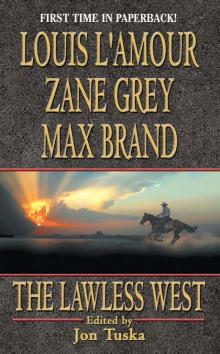 The Lawless West
 The Warrior's Path (1980) s-3
 Novel 1956 - Silver Canyon (v5.0)
 The Sky-Liners (1967) s-13
 Mustang Man s-15
 Novel 1971 - Tucker (v5.0)
 Off the Mangrove Coast (Louis L'Amour's Lost Treasures)
 Collection 2005 - Riding For The Brand (v5.0)
 Collection 1986 - The Trail To Crazy Man (v5.0)
 Silver Canyon
 The Man from Battle Flat
 The Daybreakers (1960) s-6
 Kid Rodelo (Louis L'Amour's Lost Treasures)
 Milo Talon
 Novel 1973 - The Man From Skibbereen (v5.0)
 Novel 1965 - The High Graders (v5.0)
 The Sacket Brand (1965) s-12
 Rivers West
 Novel 1970 - The Man Called Noon (v5.0)
 Education of a Wandering Man
 The Collected Short Stories of Louis L'Amour, Volume 1
 Collection 1989 - Long Ride Home (v5.0)
 Callaghen
 Collection 1999 - Beyond The Great Snow Mountains (v5.0)
 West of the Tularosa
 End Of the Drive (1997) s-7
 Novel 1986 - Last Of The Breed (v5.0)
 Novel 1966 - Kilrone (v5.0)
 Chancy
 Desert Death-Song
 Novel 1959 - The First Fast Draw (v5.0)
 Kilkenny 02 - A Man Called Trent (v5.0)
 Lost Trails
 Novel 1972 - Callaghen
 Novel 1966 - Kid Rodelo (v5.0)
 The Collected Short Stories of Louis L'Amour, Volume 2
 Collection 1983 - The Hills Of Homicide (v5.0)
 Novel 1969 - Conagher (v5.0)
 Radigan
 High Lonesome
 Bendigo Shafter
 Novel 1954 - Utah Blaine (As Jim Mayo) (v5.0)
 Collection 1990 - Grub Line Rider (v5.0)
 Mistakes Can Kill You
 The Iron Marshall
 Novel 1963 - Dark Canyon (v5.0)
 Novel 1955 - Heller With A Gun (v5.0)
 Novel 1978 - Bendigo Shafter (v5.0)
 Collection 1997 - End Of The Drive (v5.0)
 Fair Blows the Wind
 Talon & Chantry 07 - North To The Rails (v5.0)
 The Trail to Crazy Man
 To the Far Blue Mountains (1976) s-2
 Collection 1981 - Buckskin Run (v5.0)
 Collection 2008 - Big Medicine (v5.0)
 Collection 2003 - From The Listening Hills (v5.0)
 Collection 1995 - Valley Of The Sun (v5.0)
 Glory Riders
 Guns of the Timberlands
 The Collected Short Stories of Louis L'Amour, Volume Four
 Novel 1968 - Brionne (v5.0)